

Welcome to my Substack
Intellectual scaffolding for our age of serial shocks

Many years ago, a literary festival asked me to interview the legendary novelist William Gibson, one of the key figures who imagined the future we are now hurtling towards. He was touring with his 2003 novel Pattern Recognition, and at first I wasn’t sure why the festival had chosen me, since I wasn’t known for my takes on science fiction.
Then I read the book. The protagonist, Cayce Pollard, is a highly sought-after marketing consultant with an investigative eye for underground trends who also happens to be allergic to obvious displays of corporate branding. So strong is this “morbid and sometimes violent reactivity to the semiotics of the marketplace” that she has the buttons on her Levi’s jeans ground smooth to remove all corporate markings.
I had recently published my first book, No Logo, about the emergence of the first truly global lifestyle brands (Nike, Apple, Starbucks, etc.), and the young movements rising up to confront their labour and environmental predations. When I met Gibson backstage, he told me he had the idea for Pollard after coming across a copy of No Logo in an airport bookstore, and we ended up having a great conversation about globalized capital, speculative fiction and recognizing patterns in the culture before they fully manifest.
The Pattern in the Shocks
Since that encounter, I have often thought of my own work as a form of pattern recognition. In the torrent of seemingly disconnected facts that make up our “feeds,” I try to tease out the threads of connection, the recurring patterns in how power imposes itself on our lives. I wrote that first book because, as a twenty-something reporter and columnist, I saw connections being missed between the increasing precarity of work, the consolidation of ownership in key industries, and the exponential increases in marketing budgets that characterized the hollow corporate structures of those first lifestyle brands. It wasn’t a master plan that a cabal had cooked up, but there was a flow, a pattern, that wove seemingly disparate trends into a logical story about a new iteration of capitalism.
I wrote my second investigative book, The Shock Doctrine, in hopes of providing a similar scaffolding for understanding how we ended up in a world where corporations had wrestled so much political power, alongside so much previously public wealth. These were the years after the September 11 attacks, which the second Bush Administration ruthlessly exploited to strip away civil liberties at home, while weaving a profitable global web of privatized warfare and disaster response. The pattern I traced in that book involved the ways that major body blows to societies – terror attacks, coup d’etats, economic meltdowns and massive natural disasters – have been similarly exploited by elites for over half a century to push through the core policies of the neoliberal era: privatization, deregulation, and public austerity. The modern economy was born on the back of these shocks.
The most meaningful response in my writing life came when I sent galleys of that book to one of my literary heroes, the late (and deeply missed) John Berger. Many people would go on to say that they found the book enraging, but Berger’s response was very different. He wrote that, for him, the book “provokes and instills a calm.” When people and societies enter into a state of shock, they lose their identities and their footing, he observed.
“Hence, calm is a form of resistance.”
It was Berger, all those years ago, who helped me understand that the search for calm is why I write. Like so many before me, I do it to tame the chaos in my surroundings, in my own mind, and—I hope—in the minds of my readers as well. It’s also why I am drawn to writers like Berger: when I am in their hands, I notice my body changing. I breathe more deeply, drop my shoulders… the opposite of the clenched state I catch myself in when I’m doomscrolling.
Calm is Not Sedation
To be clear, calm is not a replacement for righteous rage or fury at injustice, both of which are powerful drivers for necessary change. But calm is the precondition for focus, for the capacity to prioritize and act strategically. Which may well be the reason so many powerful people seem determined to deprive us of our ability to find that focused state – whether it’s Donald Trump bombarding us with a non-stop barrage of shocks, outrages and baseless conspiracies, or Sam Altman telling us that “intelligence” is a “utility” we will soon be purchasing like electricity or water. In other words: Don’t bother making sense of reality yourself – outsource all that bothersome cognitive labour to the algorithm, and it’ll do it for you.
This points to the shadow side of pattern recognition, a theme I explored at some length in my 2023 book, Doppelganger. Conspiracy hucksters like Trump specialize in identifying patterns where none exist – claiming, for instance, that there is a global plot to “replace” white voters with Black and brown ones with the purpose of stealing elections and destroying Western civilization. And, of course, the only reason we all know Sam Altman’s name is because he and his fellow tech oligarchs have, without our consent, unleashed machines to find the patterns in the digital trails we leave behind just by existing online, and using that mechanized pattern recognition to replace us with digital doubles of ourselves.
I make this point in a meme that has gone a little bit viral recently, on this platform and others.
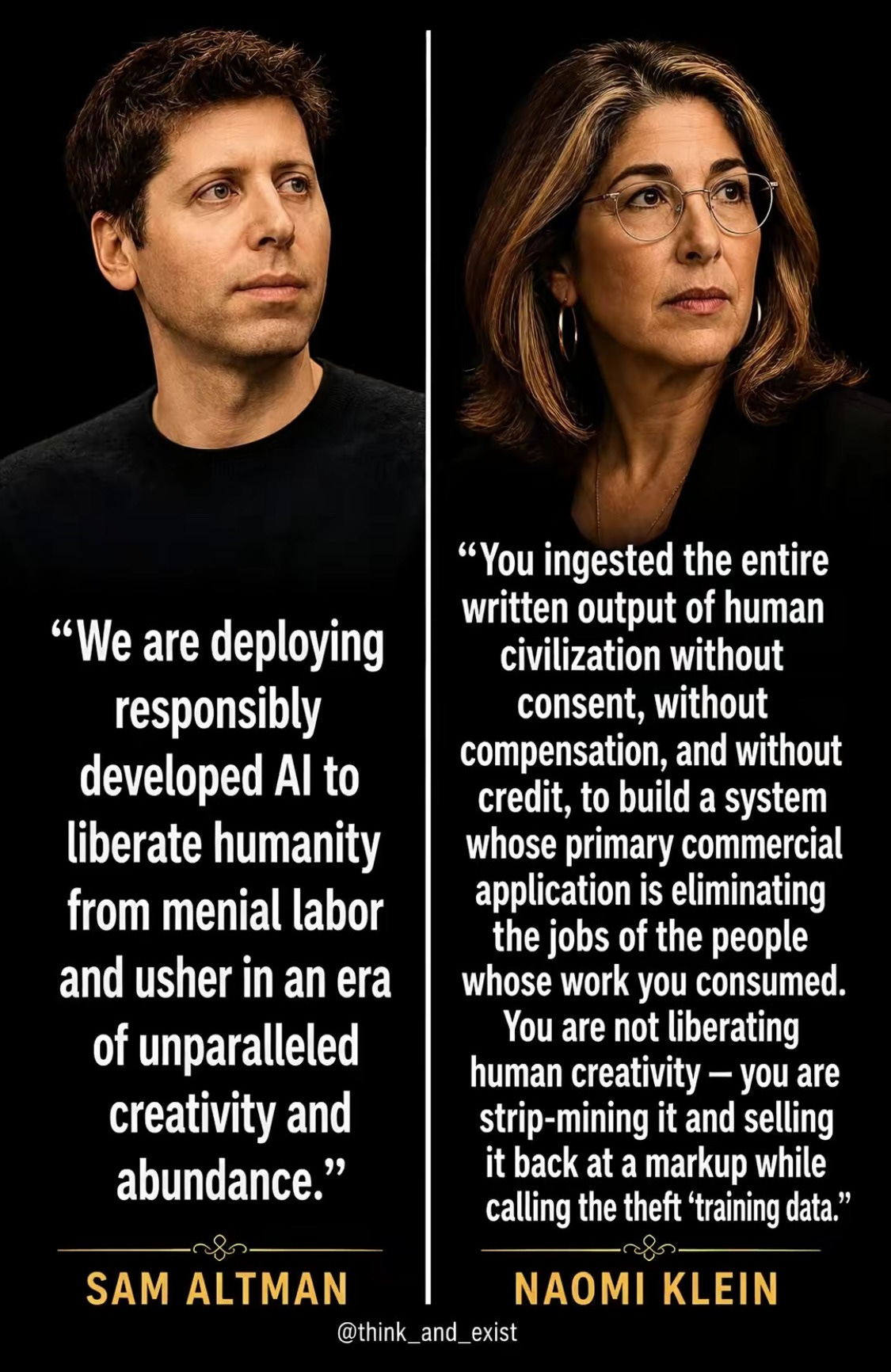
I have stumbled across it multiple times, and several people I know and respect have personally thanked me for the message. Trouble is, both my image and my quote are AI-generated, built from patterns of photographs that do exist and from very similar words I’ve actually said and written elsewhere. In truth, I agree heartily with AI Naomi. But it’s still not me, and the fact that even I was fooled at first and searched to make sure I hadn’t said those exact words (while sort of wishing I had) makes me feel the opposite of calm. (Also: what the hell is it with me and doppelgangers?)
Why I’m Here
My hope for this newsletter is that it becomes a place where we can, together, defend the precious and intensely human work of thinking and sense-making. It won’t be a one-way download of my ideas into your brains via a series of polished op-eds, but rather a forum for us to think together, identify patterns, and help one another to better understand these turbulent times in history.
One thing I have learned from three decades of book writing is that, as satisfying as it is to polish a text for months and years, the real fun begins when you take it into the world, and readers bring their own ideas, experience and brilliance to bear. Suddenly, rather than one person’s sketch of a pattern – it’s a collective topography, going places I never imagined.
You can expect me to post plenty of ideas to get conversations going, in text and video. The posts will mainly focus on current events and their impact on humans and the natural world. But as in my books, I’ll have thoughts to share about novels, films, music and streaming shows about bunkered billionaires and post-apocalyptic wastelands. I’ll include interviews – ones where I ask the questions and ones where I answer them – as well as videos of live events, essays for different outlets like the Guardian, and my Unshocked conversations with Zeteo. I’m imagining this space as a mix of a great panel discussion, a Q&A after a talk (that’s at least as good as the talk), and a rolling seminar with lots of participation.
During busy periods like book tours and elections, you can expect me to post quite a bit. That will certainly be the case in the fall of 2026, when Astra Taylor and I go on a multi-country tour in the middle of highly consequential U.S. midterm elections with End Times Fascism - and the Fight for the Living World. When I’m deep in a new creative process (we have plans…), I’ll share what I’m reading and watching to inspire me, as well as occasional snippets of works in progress.
I’ve hired a wonderfully talented journalist, Sharon Nadeem, to edit, produce, and be my partner in this endeavour, and we’ll enlist other folks as needed. If you choose to pay to subscribe, that revenue goes toward paying the people who make this happen, not into my pocket. I won’t be paywalling the core content, and for the first couple of months, while we get to know each other, nothing here will be behind a paywall.
I’m excited. Despite writing and talking a hell of a lot, I’ve never gotten around to consolidating my online presence. I don’t have a video channel, a podcast, or a social media platform where I post more than haphazardly. This became a little embarrassing recently when I was on A Bit Fruity with the brilliant Matt Bernstein. After a 90-minute deep dive into what he termed “The Tucker Carlson Problem,” Matt lobbed the standard podcast outro my way: “Where can people find you?”
I froze, then started babbling about how I barely post on X anymore, because you know, fascism, and I can’t quite get the hang of Instagram.... Rightly impatient with this middle-aged woman’s tech troubles, Matt cut me off:
“You are the first person who has answered this question with ‘nowhere.’” Ouch. Then he told his audience, “You can find Naomi at the bookstore.”
That’s true. But as of now, you can also find me here, spotting patterns and slaying digital doubles with all of you.
p.s. If you want a more official bio, you can find it here, and a more academic one here.
This place just got a lot better. Thank you Naomi❤️🙏🏽
Happy and relieved this showed up in my inbox.